
Arrest Warrants in Lee County
A Lee County arrest warrant is a written order from a magistrate, directed to a peace officer. The offense and the legal process behind it sit in the warrant and its supporting papers. Lee County publishes no roster that ties each offense to the magistrate who signed it. So don't guess which court issued a record. Read the case paper instead. Ask the clerk. This process is not a bench warrant, which follows a missed appearance. It is also not a capias pro fine, which grows from an unpaid fine or cost judgment.
How a Magistrate’s Order Becomes a Lee County Arrest Warrant
Texas Code of Criminal Procedure Articles 15.01 through 15.03 lay out how the written order is issued. The warrant must name the person or give a description. It states the offense and carries the magistrate's signature or office. A complaint or affidavit, plus a probable-cause review, backs the application. In Lee County, the work can involve the Sheriff's Criminal Investigations Division, a prosecutor, a court, and a magistrate. No local chart maps every charge to a particular judicial officer. For the statutory framework, read Chapter 15 of the Texas Code of Criminal Procedure.
What a Lee County Arrest Warrant Contains
A court or law-enforcement record may list a cause or warrant number, the issue date, the court or precinct, the magistrate, the offense, the statute, and its degree or class. It may also carry the complaint basis, an execution date, the serving agency, and bond terms. Lee County posts no fixed warrant-number pattern, no bond schedule, and no full status-code dictionary. Don't build a sample number. Don't infer bond from the charge. Ask the issuing court or the booking agency for current official details.
| Authority | Issuing court or magistrate and signature/office. |
|---|---|
| Offense | Charge, cited law, and any recorded grade or class. |
| Execution | Serving agency and return or service date when shown. |
| Release terms | Bond amount and type, or a no-bond notation if entered. |
| Current status | Ask whether served, recalled, quashed, or still open. |
District, County, and Lower Courts in Lee County
Felony cases in Lee County usually land in the 21st or 335th Judicial District Court. Those courts issue arrest warrants in the serious matters. County Court takes the county-level criminal jurisdiction and its related business. A justice of the peace can sit as magistrate and keeps the fine-only, traffic, and Class C files. Giddings and Lexington Municipal Courts handle city ordinance and citation cases. One caution: the office that issued an arrest warrant may not be the agency that serves it.
| Record route | Local office | Starting point |
|---|---|---|
| District felony | 21st or 335th District Court | District Clerk, 979-542-2947 |
| County Court case | County Court | County Clerk or court, verify file |
| JP / municipal case | Precinct or city court | Issuing court on the citation |
What Is Public After a Lee County Warrant Is Executed?
After a Lee County warrant is executed, Article 15.26 of the Texas Code of Criminal Procedure governs inspection and copying of the warrant and its supporting affidavit. That right has edges. It does not open unexecuted, sealed, or otherwise protected records. The Texas Public Information Act carries its own exceptions. Juvenile arrest-warrant records fall under Family Code confidentiality rules. So a public page may show less than the official case file. Ask the office holding the record what can be released, and keep the request narrow.
Access framework:
Article 15.26 addresses public access after execution.
Government Code Chapter 552 governs public information and exceptions.
Family Code Section 58.010 protects juvenile warrant records.
How Arrest Warrants Are Served
Several agencies share law-enforcement duty here. The Lee County Sheriff's Office, the Precinct 2, 3, and 4 Constables, the Giddings Police Department, and the Lexington Police Department all play roles. LCSO reports describe service at the Sheriff's lobby, at a residence, after an investigation, and during a traffic stop. Those are examples, not a public assignment matrix. Nor do they promise any set surrender process. Call the responsible agency before planning a voluntary appearance.
Lee County Sheriff’s Office
P.O. Box 98, 2122 FM 448, Giddings
24-hour non-emergency routing: 979-542-2800
Search Warrants Are a Different Lee County Record
A search warrant authorizes a defined search under Chapter 18, and it is not an arrest warrant or an active-person list entry. Texas law sets separate rules for its affidavit, its scope, and access to it. Juvenile process is distinct too. Family Code Section 58.010 treats a child's arrest warrant and its supporting complaint or affidavit as confidential, with limited exceptions. In Lee County, the absence of either type from an adult public list proves nothing about whether protected court process exists. Keep a record request focused on the type of process and the office you believe holds it. The rules on access can turn on execution and confidentiality.
Arrest Warrant vs Summons vs Bench Warrant in Lee County
In Lee County, an arrest warrant is a magistrate's written order telling an officer to arrest a person. A summons works differently. It gives notice to appear through its own process. A bench or FTA warrant ties to court compliance, such as a missed setting. A capias pro fine links to a fine or cost judgment. These labels blur in casual talk, so the issuing court and its record control what you are actually facing. A search warrant, meanwhile, authorizes a search and is a separate process entirely.
Before-Service Options for a Lee County Arrest Warrant
If a Lee County arrest warrant might exist, check with counsel and the issuing court before appearing anywhere in person. A Lee County lawyer can identify the court, review the case, request a recall or reset, discuss bond, and coordinate a surrender. The county posts no cash, surety, personal-recognizance, or no-bond schedule. LCSO's public line is 979-542-2800. The Sheriff page, though, gives no warrant-window schedule and promises no particular intake procedure. After service, bond covers custody and release only. Court dates, charges, and the eventual outcome are separate matters.
Federal Arrest Warrants Use a Separate Lee County Route
Federal matters in Lee County run through a different system. The county sits in the Western District of Texas, Austin Division, so federal docket questions belong to the federal court and PACER, not to any county office. Service of a federal warrant may fall to the U.S. Marshals or another authorized agency. A federal warrant can also be sealed, which means no public self-service search will show it. The Lee County Sheriff search, the JP3 payment portal, and the city court pages cannot confirm federal status. For a federal matter, ask counsel or use the federal court route. The Western District PACER/CM-ECF lookup identifies the federal docket channel.
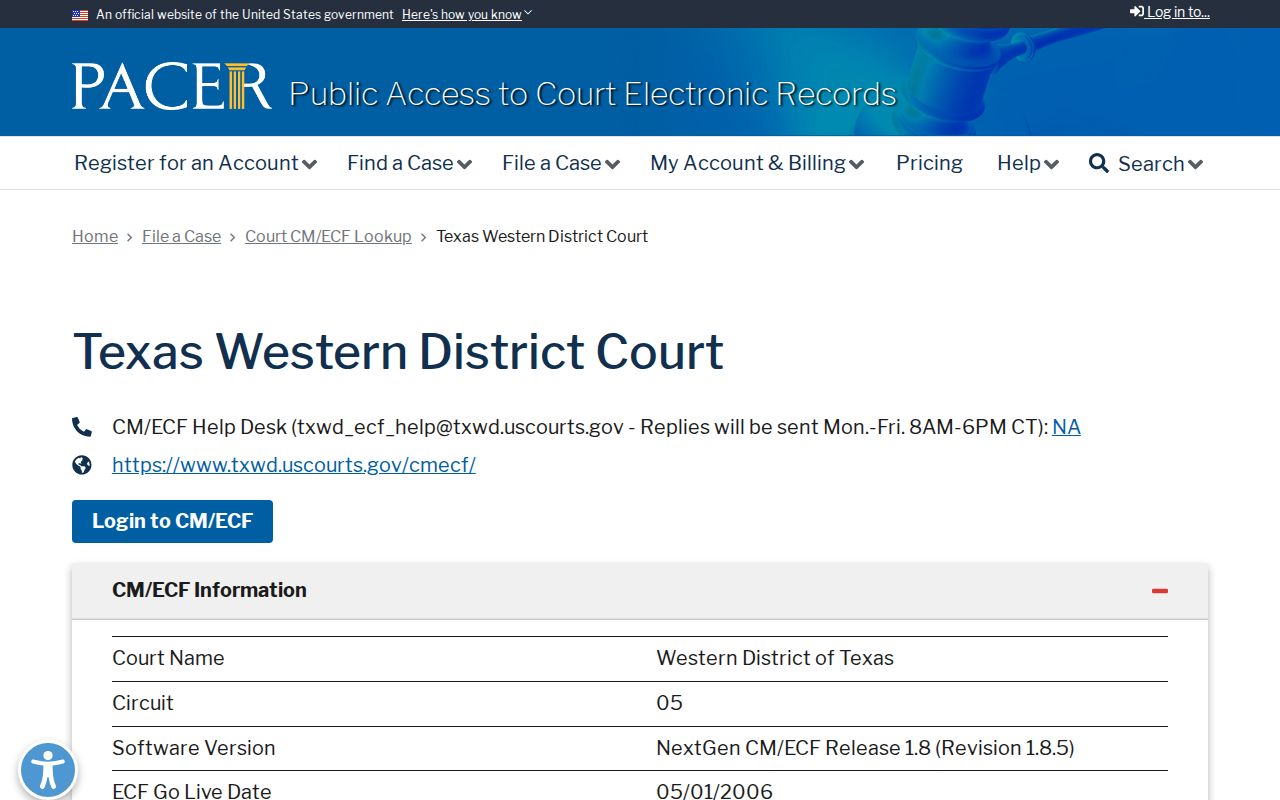
Federal cases run through a separate system, so a federal lookup result is not a Lee County warrant record.
What to Do If There Is a Lee County Warrant for You
If a Lee County warrant names you, start by writing down the court, the case number, and the contact details on the official notice. Then call the clerk. Ask whether the order is an arrest warrant, a bench warrant, or something else, and what the court requires of you. For district or felony matters, skip the fine-payment portal and do not walk into a jail without current instructions. Keep every paper: filed motions, payment receipts, bond paperwork, and any written recall or closure response from the court. A family member can help you gather case information, but only the responsible court or agency can confirm the warrant's status.
Plan before you go: consult a lawyer and call the issuing court or LCSO for the current procedure before an in-person appearance or surrender.